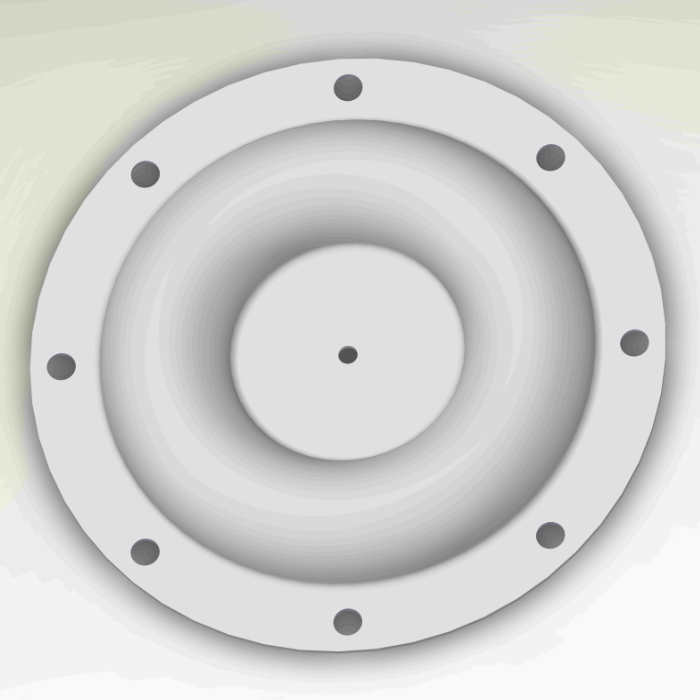
Metal Rubber™ Sheet and Fabric Materials and Devices

ABSTRACT

We report recent progress in the development of low modulus, highly electrically conducting thin film sheet and fabric materials and devices formed by molecular-level self-assembly processing methods.

1. INTRODUCTION

The objective of this work has been to develop a manufacturing process whereby highly electrically conductive sheet and fabric materials may be fabricated. Most electrically conductive materials are metals that are produced using one of many established forming methods in ingot, sheet, wire, woven screen and many other forms. The disadvantages of metals for some applications include their relatively high mass density (on the order of several to ten g/cc) and relatively high elastic modulus in comparison to polymers; metals are heavy and rigid." Conducting polymer” materials have been developed during the past several decades as an alternative to metals in some applications requiring electrical conductivity, but while they offer much lower mass densities than metals, their electrical conductivities are lower and their processing is complicated.

Another approach to forming metal-like conducting bulk materials is to create electrically conducting metal coatings on the surfaces of non-conducting materials. Conventional methods for forming such coatings typically include the vapor deposition, evaporation or sputtering of metals, or the screen printing of metal-loaded pastes or adhesives. The resulting coatings usually exhibit good electrical conductivity prior to use but experience problems when strained. Typical problems include cracking and spalling at strains above a few percent, an associated reduction in electrical conductivity, and inelastic shape recovery. For some smart structure applications, for example those requiring flexible, polymer-based actuator and sensor materials that must undergo large strains, such degradation and damage does not allow practical device application.

Methods to form stretchable metal conductors on elastomeric substrates have been investigated for some time, in part as a way to overcome these sensor and actuator problems, and more generally to address the need for mechanically flexible interconnections in polymer electronic devices, flex circuits, electronic textiles and similar applications. Of particular recent interest for example is recent work by Lacour et. al. [1] that reports electrical connectivity of 100 nm-wide gold stripes evaporated onto polydimethylsiloxane (PDMS), where non-zero electrical conductivity was observed for strains up to 22%.

We instead report electrical conductivity up to the order of 10-6 Ω.cm (less than one order of magnitude less than that of some bulk metals) in free-standing, mechanically-robust sheets of polymer/metal nanocomposite materials having Young’s modulus less 0.1 MPa, and lightweight fabrics made of individual fibers with similar properties. Such sheet and fabric materials may be strained to greater than 100%, but retain their electrical conductivity and recover their shape elastically when strain is released. Such materials may be used as electrodes for high strain sensors and as lead for high strain actuators for smart structure and other flexible electronic applications.


2. ELECTROSTATIC SELF-ASSEMBLY PROCESSING OF HIGH CONDUCTIVITY LOW MODULUS SHEET AND FABRIC MATERIALS

We have used electrostatic self-assembly (ESA) to form these electrode materials. The ESA process involves the alternate adsorption of net negatively charged and positively charged molecules from solutions onto electrically charged substrates to form regular, multilayered thin films that have order at the molecular level. The resulting macroscopic properties of the films are a function of the properties of the individual molecules, and their order and structure within the thickness of the composite film. Here we have used this process to grow thin nanocomposite films containing polymers and metal nanoclusters, molecular layer-by- molecular layer.

The concept behind the basic ESA process for the self-assembly of polymer molecules alone has been discussed in much prior work by our group and many others [2, 3]. A substrate surface, as shown in Figure 1, is typically cleaned and functionalized so the outermost surface layer has a net negative or positive charge. Then, a net surface-charged substrate is dipped into a solution containing water-soluble "cation" (or “anion”) polymer molecules that have net positively charged functional groups fixed to the polymer backbone. Because the polymer chain is flexible, it is free to orient its geometry with respect to the substrate so a relatively low energy configuration is achieved [3-7].

As a result, some of the positively charged functional groups along the polymer chain experience attractive ionic forces toward the negative substrate, and the polymer chain is bent in response to those forces. The net negative charge on the substrate is thus masked from other positive groups along the polymer chain. Those groups feel a net repulsive force due to the fixed positive functional groups at the substrate surface, so move away from that surface to form a net positive charge distribution on the surface of the substrate. Since the total polymer layer is neutral, negative charges with relatively loose binding to the polymer network pair up with positive ions.

Subsequent polyanion and polycation monolayers are added, to produce the multi-layer structure as shown. The properties of the multilayer thin-films fabricated using this method are determined by both the properties of the molecules in each monolayer and the physical ordering of the multiple monolayers through the composite multilayer structure [4]. Similar ESA processing may be realized where appropriately charged inorganic nanoclusters, typically metal nanoclusters [3], may be substituted for either or both of the polymer layers to provide a wider range of possible coating properties. Specifically, here we have combined gold nanoclusters and polymers using this basic approach to form materials that have properties typically associated with each, namely, high electrical conductivity and low mechanical modulus.

Such conducting, low modulus films may be formed directly onto a substrate, for example to form an electrode on a sensor or actuator material. Spatially patterning and attaching the electrodes to the materials may be accomplished in several ways. First, the entire surface(s) of the material may be coated with the conducting elastic materials to form opposed electrodes. Second, the surface of the substrate may be patterned chemically [8] so the deposited ESA materials only form over specific defined locations. The chemistries associated with patterning and functionalizing the substrates to promote good interfacial properties have been reported elsewhere. Figure 2 shows a recent version free-standing sheet Metal Rubber™ material with a modulus of less than 0.1 MPa. This has been designed and fabricated Maximum strain prior to rupture is greater than 1000%. Figure 3 shows the corresponding glass temperature of -70C.

Figure 4 shows recent progress in the development of electrically conductive fabric materials based on Metal Rubber™ fibers and ESA processing methods. Here, the individual fibers in the fabric mesh are each electrically conductive, and they contribute to bulk conductivity through the fabric. The low mass density of each fiber, which is on the order of that of Metal Rubber™ or approximately 1g/cc, and the open weave of the fabric, give these materials very low mass density, on the order of 0.001 g/cc or less, and electrical conductivity. Their application in smart structure systems that require electronic functionality and very low weight are suggested.


Finally, recent progress in the development of Metal Rubber™ materials with negligible change in electrical conductivity with strain is shown in Figure 5. Here, a sample of recently developed fabric is shown strained to 33% with less than 0.5% change in conductivity.

3. SUMMARY

We have demonstrated the formation of electrically-conductive, low-modulus sheet and fabric materials that may be used to form electrodes on sensor and actuator materials that are required to experience large strains due to their applications. The self-assembly approach combines conducting metal nanoclusters and mechanically flexible polymers to produce unique materials with combined properties.